
Year:
2006Price: £6.00
Forward:
There is a very short account of a homeless woman in one of Rachel Naomi Remen’s books that can serve as a marvellously heart-wrenching and mind-stopping introduction to this book. One of her colleagues, a psychiatrist like her, sees people who live on the street gratis once a month. And this one woman who lives inseparable from her shopping cart climbs one of the steepest hills in San Francisco to get to his office. But she will not leave the shopping cart anywhere – she’s afraid of being robbed and of losing all her possessions. So she starts the climb up the hill and carries a rope with her, tied at one end to the shopping cart. When she gets to a parking meter, she pulls the cart up behind her. Then she climbs again, and then drags the cart behind her. It blocks up the incline and it takes hours with her needing to rest periodically. It is hard enough for her to do when she comes once a month for her hour-long session with the doctor.
But the nurses in his office say that she comes more often than that – she comes sometimes once or twice a week. she goes into the office, ignores them except for a nod and then stands on the threshold and just looks into the room and stays there silently, sometimes for ten or fifteen minutes or a half hour and then turns around, nods to them and goes back out to her shopping cart and starts the long journey down the hill. When the nurses asked the doctor about it and what she was doing, he paused before answering. ‘I think,’ he said, ‘that she comes back to this place and stands on the threshold because she knows that entering into that room is important. It’s hard and it’s emotional, filled with tears and laughter, but it’s always filled with insight and understanding – what is giving her meaning – and if she could ever go back to living like other people do. She knows that I will only be there once a month to see her, but she comes and stands on the threshold to see herself and what she’s like when she talks with me – she comes to see herself and to remember when she needs it. And she does her own hard work alone when she discovers something and then, she will have it in her mind when she comes to talk to me about it.
The threshold for most of us, a threshold is for passing over, crossing over into a room or exiting and we barely think about it. How often do we stand on a threshold in a doorway, the entrance to a house or a building, or even at a gate or a door and just stand there before we enter? Oddly enough that’s what this book is all about: thresholds. Each short reflection – they alternate between prose introductions and more free verse reflections – serves as a threshold. The book begins with the thresholds of seasons of the liturgical year, Advent/Christmas, and then jumps to Lent/Easter and then ordinary time reflections that can come whenever, out of the blue, the product of long keeping and letting it sift and percolate. But you don’t have to read the book liturgically – many of us find ourselves often out of synch with the liturgical year because of what is happening historically in the public arena or what is happening to us personally in our families, our work and our spiritual lives. The Spirit doesn’t always follow liturgical time sequences.
A threshold- you can’t read this book quickly. You do have to stop, arrested – and after the introduction piece, stand on a threshold or, if you know that you are going to be there a while, get comfortable in your favourite chair, pew in church, or a wall or place outdoors so that you can mull over and reflect at your leisure. Ruth Patterson’s words sound familiar and they speak of things we all experience but they have a character that stops us in our tracks and nudges us to savour, to wonder, to question and examine, and cull from her wisdom into the vagaries of our lives.
Thresholds – Ruth has lived like the rest of us, with family and job, loss and grief, nephews and nieces, loneliness and solitude, in church and in the world. She has also lived in a specific historical period, in the north of Ireland – the last sixty years and so the thresholds also, of necessity, deal with torture, insecurity, disappearances, brutality, murder, the indignities and horrors that human beings are capable of and do to one another in the name of sectarian politics, economics/poverty and religion. Sometimes the reflections are singularly personal and yet they are always turned to shift light and focus on the universal experience of struggling to live with grace in the face of evil and the consequences of just being alive in the world at this time.
And like the woman in the story with all that she owns piled in her shopping cart that she won’t part with, even when dragging them around with her, that makes her life incredibly more difficult than necessary – most of us will approach this book in the same way. Oh, we don’t have a shopping cart and we’re just as attached to so much in the past that impacts our present realities – burdens we have been given by others, memories, things we have done and not dealt with, huge questions that don’t have answers, or they seem to get answered and then they spring up and bow us down yet again. Each of us needs a place, a friend, a time and words to help us return to ourselves, to see ourselves and how we do fit into the rest of the world, others’ lives and into the kingdom of God and the will of God.
God is laced through all of these pieces. There is the God of the Scriptures, the Word of God made flesh in Jesus, incarnated human, as one of us. There is the God of Jesus, the beloved Father who is Jesus’ constant companion whom he seeks to delight and reveal with his words and his presence, to all in the world he dwells in, and those he dwells among. And there is the God of the Spirit that is given in gifts for others and in insight and power – to survive the twists and unexpected drops and dark holes that are a part of life often because of the actions of other people, along with the shared joy and everyday pleasures. There is the God that is the sacrament of the world and a dialogue with this God, seeking to understand the languages of history, of political issues, of violence and death that is stupid and unnecessary and only contributes to despair and making life so much more of a burden than a delight. And there is the God of the Trinity, of community, of family that seeks to draw everyone into its embrace. This is the God that Ruth Patterson has met, often enough to come to know a little, and this is the God that seeps out in these pages.
Life and the world of the last sixty years have been different than much of time that has transpired and gone before 1945. There has been the atom bomb, the end of the Second World War with the calculated terror of Nagasaki and Hiroshima. There have been more wars since: the Vietnam war, the cold war, the arms race war and countless internecine wars that people must deal with close to home – in the Middle East, in Latin America and Southeast Asia, and, for Ruth Patterson, the war of hate, of crime and terrorist attacks of Northern Ireland- called the ‘Troubles’ euphemistically. This closeness and nearness, this ordinary everyday threat of evil impacts and shadows every moment and every relationship, including our inner life of prayer, penance and the struggle to be just and truthful and reconciling. And these public issues Ruth Patterson has struggled with – not to be overcome by them or embittered, but to redeem them, to draw forth hope from them and see them in the shadow of the cross and resurrection of Jesus. And it is in this regard that these reflections perhaps can touch us most deeply, scratch at our comfortableness and accommodations and prod us to bring the Gospel, the Good News of God in Jesus to bear on what is happening in our world, in our history, now.
Ruth works at Restoration Ministries in Belfast, a small group that seeks to draw people together in conversation and to honestly look at differences, especially in regards to religion and politics – often of long-standing intense emotional feelings and prejudices, as well as experiences. We bring so much hurt, so much repressed anger and fear, so much unresolved hate and human loss to our daily lives and encounters. And these are so often exacerbated by events and public personages who play on these personal weaknesses and human failings to escalate violence and deepen these gulfs between us. It is painfully hard to just get in touch with one another and to stay in touch with anyone who is not of our immediate circle of trusted kin and friends. This is what the work of Restoration Ministries is about – not just for those in the city of Belfast, or in Northern Ireland, but also for the country at large.
There is a remarkable medieval story that gives one a sense of the emotional impact and the theological ponderings of this book. I’ll tell you the name I give it at the end of the story. Once upon a time a young woman was expelled from heaven because even though she had lived a not unusual life, she still harboured a lot of resentment and lack of compassion for others – and there were many she hoped would not make it into heaven because of things they had done to hurt her and those she loved. As she was leaving heaven, one of the others watching her go leaned over and whispered that they’d let her back in if she could bring back a gift for God – one of the few things that God valued more than so many other gifts that were often given. And so she travelled the earth looking for gifts – things she thought that God might take delight in and so let her come in to stay.
She made so many trips back and forth to heaven bearing the gifts carefully chosen and acquired from earth. There were things like a faded photograph of a couple who had been faithful for so many years; the last coins that an old man had given to someone even poorer than himself; there was a child’s toy given to another though the toy was her favourite. There was the blood of a martyr shed in witness to the faith and the washcloth of a woman who had cared for her elderly parents for a decade, along with a missionary’s cross that was the only possession they had from their home country. But she wasn’t let back in.
One day she was sitting in a small village, at a fountain, just watching and wondering if she’d ever be let back into heaven- she felt like crying but that wouldn’t help – she had to find another gift. As she sat there forlorn and alone she noticed some young children playing and that they were slowly inching their way closer to the fountain and all of a sudden they were up and over the edge and into the water! They were splashing each other, dripping wet and laughing with wild glee. A man rode up just at that moment. He was wearied with battle and killing and thirsty and just wanting to get home from war. He got down from his horse and bent to drink from the fountain and noticed the children so filled with joy and his heart lurched. He remembered his own childhood and how filled with hope he had been, so filled with dreams and possibility and he saw his own reflection in the water and wept. He wept for shame, for loss, for repentance, for forgiveness, knowing all he had done; the harm he had inflicted on others and what he had lost of his own integrity. He wondered if his soul looked as torn and shredded as his clothing and as soiled and bloodied as his armour – and he wept and wept. She moved quickly and silently, unseen and caught one of his tears and turned for heaven. She found herself on the threshold of heaven and realised that she herself was weeping in gratitude for mercy and for joy. I call it “The Tear.”
On every page of this book are tears – of gratitude, of loss and pain, of fear from the long shadows of terror that are always vague, and sometimes specific in their evil and of joy from the simple pleasures of the birth of a child, a marriage, a dinner shared with friends and moments of adoration, of the beauty of the earth and the lingering absence that is often the experience of our God. it is a very Irish book, as my Nana would say – meaning that ‘life is a glorious thing, if you don’t weaken – and if you do, then when you stagger and fall, get up and make a piece of poetry out of it, sing for God’s sake and grasp hold of someone and hold on for a dearer life.’
And there are tears that are shared around the world. In one of my visits to Ireland in the last years, to the west coast, the three of us travelling together stopped at a Chinese restaurant in Galway. It was a most amazing universal experience. one of my companions had spent years in China, the other in South America as missionaries and we had conversations in Mandarin with the owner, in Spanish with the busboy and the girl who brought our food taught us words in Gaelic, while the couple visiting at the table next to us was from Bosnia, and we spoke with them in English, and smatterings of Italian and Arabic. This book in its own small way is a place of refuge, of sanctuary gleaned from a life of truly living and a threshold – an invitation to enter and know the presence of heaven, that is as much here on earth as anywhere else. Catherine of Siena proclaimed in hope that ‘For anyone who believes in Jesus the Crucified risen from the dead, then all the way home to heaven, is heaven!” This book will steadfastly remind us of that reality, in the midst of a world veiled in tears and laughter. Turn the pages and begin the habit of standing hesitant, expectant and consciously on thresholds.
Megan Mckenna
Albuquerque, New Mexico
September 2006.
About This Book:
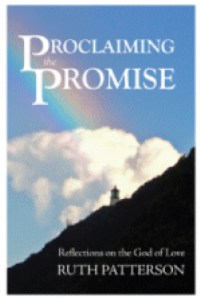
Proclaiming the Promise: Reflections on the God of Love is a book of reflections that have emerged as Ruth has journeyed through specific events, times and seasons, and as she has travelled in her spirit through some of the sacred moments of the cycle of the Christian year.
While these reflections are largely born out of a life shaped by the last forty years or so of Ireland’s story, the underlying themes are universal. It is Ruth’s prayer that the thoughts and images in this book may enable the reader to see beyond the immediate and be seized by hope in the present and for the future.
Rev. Dr Ruth Patterson OBE is a Presbyterian minister and the Director of Restoration Ministries, a faith-driven organisation that seeks to restore broken persons and broken society through prayer, listening, hospitality and teaching. In January 2003 Ruth was awarded an OBE for her work in reconciliation. Her recent publications include Journeying Towards Reconciliation: A Song for Ireland (Veritas, 2003).
What Others Say:
From my bookshelf, Tom Kiggins
If you would like a little book that you can dip into now and then for encouragement, wisdom, hope and gentle humour, you should get your hands on Proclaiming the Promise. The author Ruth Patterson is a Presbyterian Minister who has made reconciliation in Northern Ireland her life-work.
I have chosen some passages from the book which give a flavour of the fine writing and an indication of the author’s deep faith and insight. Reflecting on Advent, she writes: “We are called, all of us, not to strive to hold back the dark, and sometimes it can be very, very dark, but rather to enter into the heart of it with the confidence of an Advent people whose hallmarks are hope, joy, peace and love.”
Writing of John the Baptist she asks:
“Where are those who will pick up John’s mantle
and seek to be prophets today?
So often their voices are silenced
There’s no one to point out the way.
Corruption, greed, fear are our masters
In this wilderness, what can we do:
Pray for voices to speak out with
courage,
and someday that voice could be you.”
The choice between Barabbas and Jesus put to the crowd by Pontius Pilate inspires her to write: “Jesus still comes. He stands before us and in his very coming offers us the choice. Ecce Homo! Here is the man! If we dare to choose him it will not be an easy way. It will be a cross-bearing way as it has been for many throughout the years, those who have borne the cross of beginning to see things differently and then being courageous enough to act upon it. It is a hard choice, but one that will mean new life for us as individuals, for this island and for this world.”
Of the Eucharist she notes; “Every time we come to the sacrament of communion, Jesus himself puts flesh again on the past. He comes to us in the bread and wine. He really hears us. And in the stillness of the moment he asks the question and responds with the answer at the same time. Remember me? I am the one who hung on that cross for you. I am the one who loves you. And I have prepared a place for you.”
For Ruth Patterson, the fact that Mary Magdalene was the first
to encounter the Risen Christ bears unique testimony to the equality
and dignity of women. She writes:
“Could it be that in that garden,
on that morning long ago,
God especially chose a woman
so that she might rise and go
to her brothers, hurt and grieving
with her passion and her grace
to hear from her the glorious message,
‘I have seen him face to face!”
Africa Magazine, July/August 2009 (Book Review)